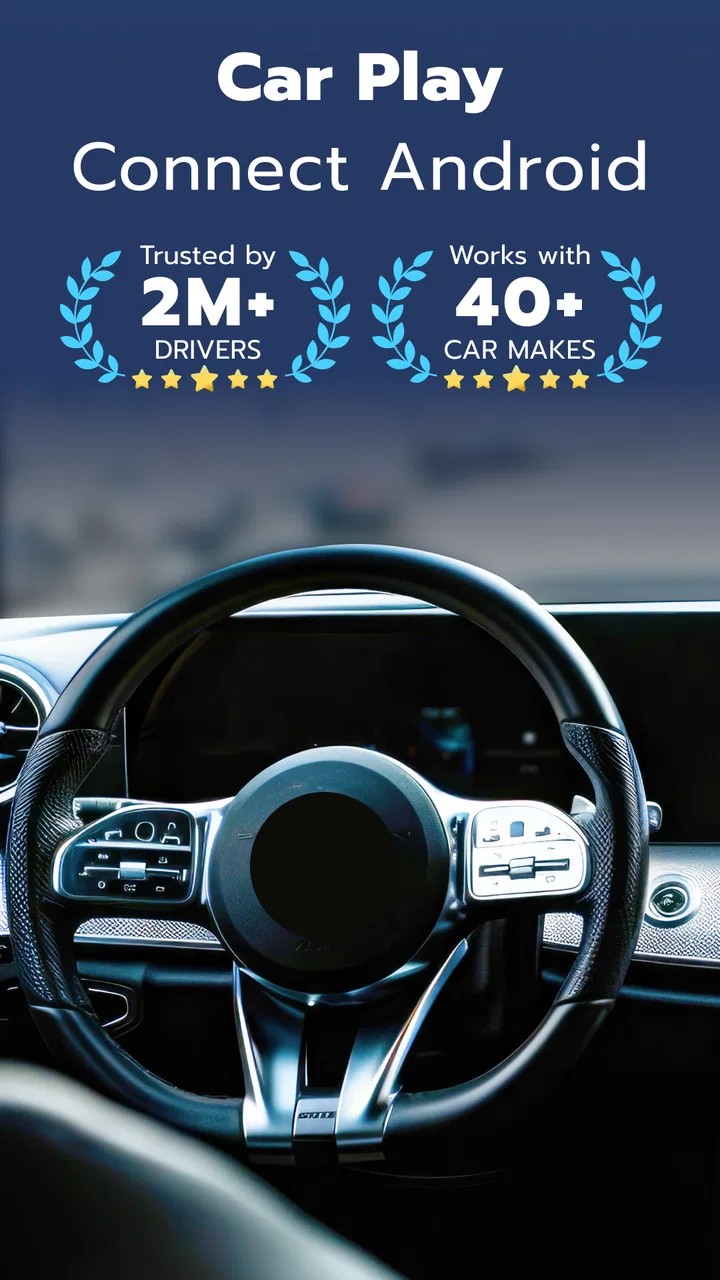
Car Play Connect for Android
- 4.3
- Rating
- 100.00K
- Installs
- Free
- Price

 Analysis by App-foxy
I approached Car Play Connect as a practical question rather than a novelty: can it make a regular Android phone feel more useful inside a car without forcing me to rebuild the way I drive? Its purpose is straightforward. It connects the phone to the car and brings together navigation, maps, calls, music, and car-status information in one driving-oriented experience. That sounds simple, but the value depends heavily on how much you want from an in-car interface and how much setup friction you are willing to accept.
After using it as an Android Auto-style companion, my impression is that it is most appealing to drivers who want a central screen for everyday phone functions instead of constantly handling the handset. It is free to download, aimed at everyone, and developed by LeoStudio Global Ltd. The app has built a 4.5 average from around four thousand ratings, with more than one hundred thousand installs, so it is not an obscure experiment with no user base behind it.
The important distinction is that this is not simply a navigation app. A navigation-only tool is designed to get you from one place to another. Car Play Connect tries to sit between the phone and the vehicle, giving driving-related functions a shared space. That makes it more convenient in some situations, but also means that the quality of the experience depends on the phone, the car display, the connection method, and the apps you expect to use alongside it.
You May Also Like

 Google Keep - Notes and lists
Google Keep’s Quiet Growth Shows the Appeal of Simpler Notes
As mobile work gets busier, Google Keep keeps winning a simple contest: capture a thought quickly, find it later, and get on with the day.

 Blood Strike: 2.5 Anniversary
Blood Strike’s Loadouts Turn Every Drop Into a Tactical Gamble
A close look at Blood Strike’s custom loadouts: how fast access to signature weapons reshapes its battle royale rhythm, rewards preparation, and narrows the gap between fights.

 Pandora - Music & Podcasts
Pandora’s Music Is Easy to Start, but Harder to Recover
Pandora’s strength is its low-effort path from a seed to a station. Its weak spot is how much confidence it asks you to place in connection, setup, and quiet recovery.

 8 Ball Pool
 Is Built on Rivalries, Rematches, and Routine
A close look at the rivalries, rematches, shared routines, and unanswered safety questions that turn a quick pool match into a persistent mobile community.

 Samsung Music
’s Quiet Strength Is Playing What You Already Own
Its reach comes less from spectacle than from dependable access to a personal library. That simplicity is both the app’s strongest retention engine and its ceiling.

 AccuWeather: Weather Radar
AccuWeather Review: A Quick, Clear Forecast for Everyday Decisions
For everyday plans, the best forecast is the one you can understand quickly. AccuWeather makes rain timing, radar, and local conditions easy to act on, with a few trade-offs.
More From Our News Desk



What I looked for before recommending it
My first decision criterion was connection reliability. An interface can look polished, but it is not useful if I have to repeat the pairing process every time I start the car. With this kind of app, I would pay attention to whether the phone recognizes the vehicle quickly, whether the display remains active during a longer trip, and whether switching between navigation, calls, and music feels predictable. Those details matter more than decorative graphics because they determine whether the app reduces distraction or adds another thing to manage.
The second criterion was screen practicality. A car-friendly interface should make the most common actions easy to find with limited attention. I wanted map controls, navigation access, phone calls, music controls, and vehicle-related information to feel like parts of one workflow rather than separate phone activities placed next to each other. Car Play Connect is strongest when I use it as a dashboard companion: start the route before moving, choose audio before leaving, and keep the phone out of my hand while driving.
I also considered what happens when the app is used outside the ideal scenario. A short commute with a familiar route is forgiving. A long unfamiliar drive, a weak connection, or a car with an awkward display exposes weaknesses quickly. My recommendation therefore depends on whether you want a convenient bridge between Android and the car, or a fully integrated system with deep control over every vehicle function.
One useful habit is to prepare the session before pulling away. I connect the phone, select the destination, check that audio output is going to the expected source, and then put the handset aside. This small routine avoids the common mistake of trying to solve connection or music problems at a traffic light. It also reveals whether the app fits your car: if the basic sequence feels annoying before the trip begins, a more specialized alternative may serve you better.
The everyday commute test
Imagine leaving work in the evening with a new address to visit. I would connect the Android phone, open the driving interface, set the destination, and start the route while the car is still parked. If a call arrives, I can move from navigation to the phone function instead of reaching for the handset. If I want background audio, the music area keeps that task close to the route rather than requiring a separate search through the phone.
This scenario shows the app’s practical advantage. It does not necessarily make every individual function better than a dedicated app. A specialist navigation service may offer a richer map experience, while a music app may be better for browsing a large library. The benefit is the shared driving context. I can access the main tasks from one place, which is especially useful when I want fewer visual and physical interruptions.
There is also a less obvious benefit for drivers who use different cars. If I regularly move between a personal vehicle, a family car, and a rental car, a phone-based solution can be easier to carry from one vehicle to another than relying on a single built-in infotainment system. The trade-off is that the experience may vary from car to car. A connection that feels smooth in one vehicle may require more attention in another, so I would test it in the car I use most rather than judging it only from a quick installation.
Where the app is most convincing
Car Play Connect wins when the main problem is fragmentation. Without a centralized interface, I might use one app for directions, another for music, and the phone screen for calls. Even if each app works well alone, moving between them can make the driving experience feel disjointed. The app’s value comes from bringing those familiar driving tasks together in a single environment.
Its vehicle-oriented presentation also makes more sense than simply placing the phone in a dashboard holder. A holder improves visibility, but it does not automatically create a coherent control layout. With this app, the goal is to make the phone behave more like an in-car display. I still need to use good judgment and avoid interacting with it while moving, but the arrangement is more suitable for preparing a trip and checking essential information briefly.
Another strength is its broad usefulness. Someone who only wants turn-by-turn directions may find it more than necessary, but a driver who also takes calls and listens to music can get more from the combined design. It is particularly sensible for Android users whose vehicles do not offer the exact phone integration they want. Rather than buying a new phone just to change the in-car experience, they can first try a software-based approach.
I also like the possibility of using the car-status area as part of a quick pre-drive check. I would not treat an app display as a replacement for the vehicle’s own warning systems or the owner’s manual, but having status information near navigation and media can make the dashboard feel less scattered. The key is to use it as a convenience layer, not as a reason to ignore the car’s native indicators.
Small workflow changes that make a difference
The first practical tip is to separate setup from driving. Complete pairing, destination entry, and music selection while parked. This is more than a safety reminder: it also gives the app time to establish the connection before the vehicle is moving, making it easier to identify whether a problem comes from the phone, the car, or the app itself.
The second is to keep the phone’s role simple. I would avoid treating the interface as a replacement for every phone feature. The more tasks I try to perform through a car display, the more likely I am to create clutter and distraction. Car Play Connect works better when I limit it to the functions it is designed to bring forward: maps, navigation, calls, music, and car-related information.
The third is to evaluate it over several types of trip. A familiar commute tests convenience, while an unfamiliar route tests navigation access and screen readability. A short stop tests whether reconnecting is painless. A longer drive tests whether the interface remains comfortable to use. This approach gives a more honest result than installing it, connecting once, and assuming the experience will always be the same.
When another approach may be better
Car Play Connect is not automatically the best choice for every Android driver. If your car already has a dependable native system that handles navigation, calls, and music exactly as you like, adding another connection layer may not improve anything. In that case, the built-in interface may be simpler because it is already designed around the vehicle’s controls and display.
A dedicated navigation app may also be the better option for someone who cares almost exclusively about route planning. Specialist navigation tools often make their maps, route preferences, and location search the center of the experience. Car Play Connect is more useful when I want navigation to coexist with other driving functions, not when I want an advanced map workspace and nothing else.
Drivers who spend most of their time listening to music may prefer direct control through the vehicle’s existing media system or the music service’s own interface. The combined approach is convenient, but it may not offer the same depth for browsing playlists, albums, or recommendations as a purpose-built music experience. I would choose the app for access and continuity, not because it replaces every specialized feature.
There is a similar trade-off with calls. The app can make phone access more appropriate for the car, but drivers who need extensive contact management, messaging, or business communication should be cautious about turning the dashboard into a second office. The safest and most comfortable use is limited interaction before driving and brief, necessary control while stopped or through suitable hands-free methods.
Compatibility expectations are another reason to compare alternatives carefully. The app requires Android 8.0 or later, which covers many still-used phones but excludes older devices. The current version is 3.1.4, and I would keep the app updated when possible because connection-focused software benefits from ongoing maintenance. Still, an update cannot make every phone-and-car combination behave identically. If your vehicle has unusual infotainment hardware, I would treat a real test connection as essential before depending on it for an important journey.
The free entry point is attractive, but the presence of in-app purchases means I would review any optional upgrade screen carefully before confirming it. The listed purchase range runs from $4.99 to $99.99 per item. That does not make the free version a poor choice, but it does change how I evaluate it: I would first establish whether the basic connection and driving workflow solve my problem, then decide whether any paid element is worth the cost.
For a driver who dislikes adjusting settings, a native system may remain more comfortable. For someone who enjoys customizing a phone-based setup and wants to carry the same general workflow between vehicles, Car Play Connect has a stronger case. The decision is less about which option sounds more advanced and more about whether you value flexibility over deep vehicle integration.
The real cost of changing systems
Switching to a new in-car interface has a cost that is easy to overlook: learning where everything is. Even a free app can require time to establish a routine, adjust the phone position, understand audio behavior, and decide which functions should be handled before departure. I would not install it immediately before a long trip. A short local drive is a better test because it lets me learn the workflow without making the journey itself stressful.
There can also be a habit cost. If I am used to pressing physical controls for volume or calls, a phone-centered interface may feel less natural at first. Conversely, if I am accustomed to holding the phone for navigation, the app may feel like a meaningful improvement because it encourages a more settled dashboard arrangement. The right result depends on the controls already available in the car.
Privacy and attention deserve practical consideration too. The app connects driving tasks to the phone, so I would be selective about which functions I expose while on the road. I would also avoid exploring unfamiliar menus during movement. The best setup is one where the route and audio are ready in advance, calls are handled as safely as possible, and the screen is consulted only when necessary.
The app’s age rating of Everyone makes it broadly accessible, but that should not be confused with unrestricted suitability for every driving situation. The content may be appropriate for a wide audience, while the responsibility for safe use remains with the driver. I would never use the rating as a reason to let a passenger or child experiment with the interface while the vehicle is moving.
Because the app is free to start, the financial risk of testing it is lower than buying dedicated hardware. That is one of its strongest decision advantages. I can see whether my particular phone and car cooperate before committing to a larger change. The main investment is time: pairing, testing, and building a pre-drive routine.
Who should install it
I would recommend Car Play Connect to an Android driver who wants one driving-focused place for maps, navigation, calls, music, and car status, especially when the vehicle’s existing phone integration feels limited. It is also worth trying for people who switch between cars and prefer a phone-based workflow rather than learning a completely different infotainment system in each vehicle.
I would be more cautious about recommending it to someone whose car already delivers excellent native integration, or to a driver seeking a highly specialized navigation tool. It may also disappoint users who expect the app alone to solve every compatibility issue between an Android phone and a particular vehicle. The app can organize the experience, but it cannot remove every hardware or connection variable.
Before relying on it, I would perform a simple checklist while parked: connect the phone, confirm that the car recognizes the interface, start a short route, test audio, and make sure the essential controls are easy to reach. Then I would repeat the process after ending the trip and reconnecting later. This catches the kind of small friction that a store description cannot reveal and tells me whether the app is genuinely convenient in my own car.
My recommendation after using it
My verdict is positive, with a clear condition: Car Play Connect is best viewed as a practical Android bridge to the car, not as a universal replacement for every native or specialized driving tool. Its strongest idea is the combination of core road functions in one interface. That combination can make daily driving feel more organized, particularly for people who currently jump between separate phone apps.
The free price makes experimentation easy, while the Everyone rating and support for Android 8.0 or later keep the entry requirements approachable for many users. LeoStudio Global Ltd. has also given the app a substantial enough presence to make it worth considering rather than dismissing it as an untested utility. I would still pay attention to optional in-app purchases and judge the experience by actual connection performance in my own vehicle.
My practical recommendation is to try it for a week of ordinary trips before making it your default system. Use it for the commute, one unfamiliar destination, and a reconnect after stopping the car. If it consistently reduces the need to handle the phone and keeps navigation, calls, music, and vehicle information within a sensible reach, it is a useful addition. If your native system already does all of that smoothly, or if the connection routine becomes another daily annoyance, staying with the built-in option is the smarter choice.
For me, the app earns its place because it focuses on a real everyday problem: turning several phone-based driving tasks into one more coherent experience. It is not perfect for every vehicle or every type of driver, but it offers a low-risk way to test a more connected dashboard without immediately changing hardware. That makes it an easy recommendation for curious Android users, provided they test it parked first and keep their expectations centered on convenience rather than complete vehicle control.
FAQs for Car Play Connect for Android
01What is Car Play Connect for Android and how does it work?
Car Play Connect for Android is an app designed to bring Apple CarPlay functionalities to Android users. It works by mirroring your phone’s interface onto your car’s display, allowing you to access navigation, music, and messaging apps easily. It provides a seamless driving experience by integrating with your car’s existing infotainment system.
02Is Car Play Connect for Android compatible with all cars and Android devices?
While Car Play Connect for Android aims to work with a broad range of vehicles and devices, compatibility can vary. It requires a car with a compatible infotainment system and an Android device running a specific OS version. Check the app’s compatibility list or contact support to ensure it will work with your particular setup.
03How secure is the Car Play Connect for Android app?
Car Play Connect for Android is designed with security in mind, using encryption protocols to protect your data while connected. However, as with any app that interfaces with your vehicle, it’s important to download it from a reputable source and ensure your device’s security features are up to date to prevent unauthorized access.
04What features does Car Play Connect for Android offer?
Car Play Connect for Android offers a variety of features, including navigation, music streaming, and hands-free calling. It also supports voice commands, allowing you to keep your hands on the wheel while accessing apps. Additionally, it integrates with popular messaging apps, enabling you to send and receive messages without distraction.
05Are there any known issues or limitations with Car Play Connect for Android?
Some users have reported occasional connectivity issues, such as lag or disconnections, particularly with older or less powerful devices. Additionally, not all apps may be fully supported or optimized for the car’s display. It's advisable to check user reviews and the app’s official support page for any known issues before downloading.
Pros
- Seamless integration with car systems.
- User-friendly interface with minimal setup.
- Supports a wide range of Android devices.
- Real-time navigation updates and alerts.
- Hands-free control for safer driving.
Cons
- Limited compatibility with older car models.
- Some features require in-app purchases.
- Occasional connectivity issues reported.
- High battery consumption during use.
- Voice recognition can be inconsistent.

Car Play Connect for Android
Gallery